
How IPL Teams Are Formed – Auction Rules & Player Categories (2026 Detailed Guide)

Table of Contents
The Indian Premier League, or IPL, is more than just a cricket league. It’s actually amongst the most effectively formed leagues of its kind around the globe. The key to its thrilling competition is, of course, its ‘IPL team formation’ process. In this guide written specifically for the year 2026, we will cover each and every aspect of forming or buying players for a particular IPL season, from buying procedures to auction norms, player types, salary cap restrictions, and foreign player restrictions.
For more information on this structure and the way in which players are selected, refer to the Indian Premier League entry in Wikipedia.
What Is IPL Team Formation?
The IPL team formation is basically the manner in which each IPL franchise is able to form its lineup to compete during the season. It is important to note that these franchises, instead of picking the lineup randomly; they select the lineup by adhering to the IPL auction guidelines.
Teams can get new players by:
- Keeping players from the previous season
- Purchasing players for the IPL auction
- Signing new players to replace outgoing ones
Each of these phases has certain regulations to ensure competition balance and fiscal equity.
Player Retention: Planning Before the Auction
Before the auction begins, franchises have the chance to retain a certain number of players from their existing roster. Retention allows teams to secure core players without entering competitive bidding at the auction later.
Key Retention Rules (2026 Snapshot)
- Teams can retain selected players before the auction.
- Retained players’ salaries are deducted from the team’s total salary cap before the auction purse is calculated.
- There is no strict cap on the number of retentions in mini auctions, unlike mega auctions – but teams must still balance their overall squad limits and finances.
Retention strategy plays a crucial role because it allows franchises to keep their key performers and structure their remaining purse around the auction for maximum squad value.
IPL Auction Rules Explained
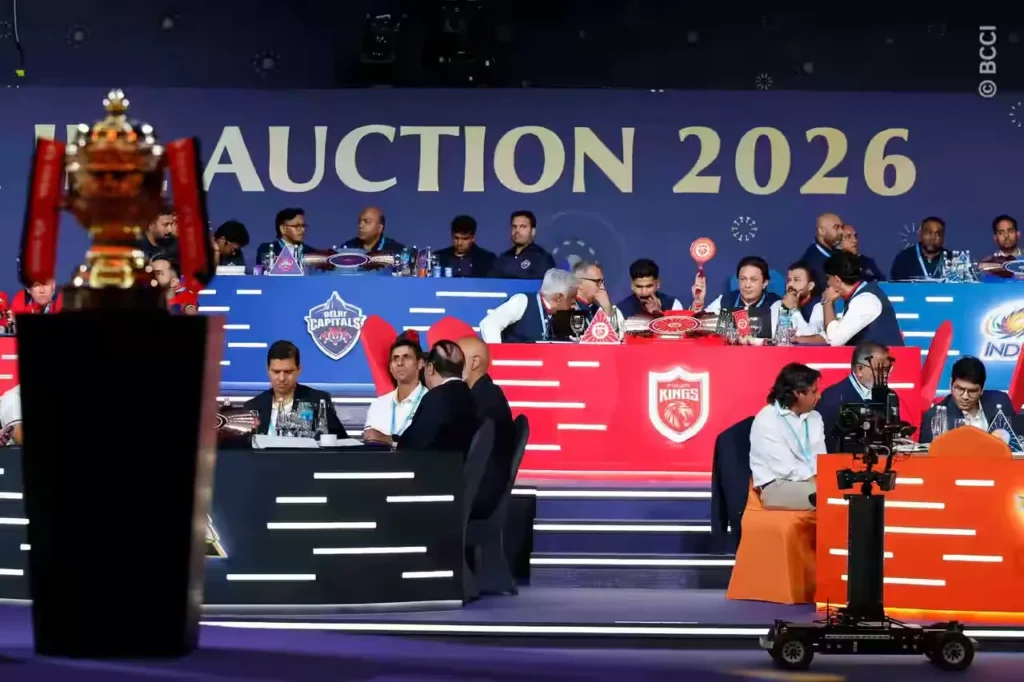
The auction is the main event to form the teams in the IPL. At this venue, the franchises bid to buy players from the pool of available cricketers. Whether it is a mega auction-it happens every couple of years-or a mini auction-a smaller pool of players that occurs between mega cycles-the core auction principles remain the same:
Central Auction Basics
- All players not retained go directly into the auction pool.
- Teams are required to use their allocated purse to ‘buy’ players against other teams’ bids.
- Once a franchise wins a bid, the player joins that team’s squad for that forthcoming season of the IPL.
The different strategies for auctions differ from team to team; nonetheless, most bids involve a continuous juggling of star power as opposed to emerging talent, filling immediate positions of need, and maintaining budgetary constraints.
IPL Player Categories: Who Can Be Bought?
Players entering the auction are generally classified based on experience and status:
- Capped Indian Players
- Experienced domestic or international players with national team experience.
- Uncapped Indian Players
- Domestic players without international caps are often younger talents or new performers.
- Capped Overseas Players
- International stars with experience playing for their national sides.
- Uncapped Overseas Players
- Foreign players are yet to play at the international level.
Each category comes with different base prices set before the auction. Typically, capped players attract higher bids due to proven performance, while uncapped talents often represent value picks.
Salary Cap in IPL: Managing the Purse
Every franchise in the IPL must manage its finances within a defined salary cap. For the 2026 season:
- The salary cap per team is approximately ₹120 crore.
- The squad must have a minimum of 18 players and a maximum of 25 players.
- Minimum spending requirements often apply (for example, teams must spend at least a percentage of their total cap).
Salary caps ensure that richer franchises cannot simply outspend others, maintaining league competitiveness and preventing financial imbalance.
Overseas Player Limit in IPL
One of the most notable regulations in IPL team formation is the limit on foreign players:
- A franchise squad may include up to 8 overseas players in total.
- In any match, no more than 4 overseas players can be part of the playing XI.
This rule promotes Indian talent by ensuring that domestic players make up the majority of the playing team, while still allowing franchises to benefit from international experience.
Special 2026 Rules: Overseas Salary Cap
As part of the IPL auction rules for 2026 mini-auction cycles, a noteworthy regulation was introduced regarding overseas player salaries:
- Overseas players’ earnings are capped at ₹18 crore, even if bidding exceeds this amount.
- If a franchise bids more than this cap, the excess is taken by the IPL governing body into a centralised fund.
- Indian players are exempt from this cap and receive their full bid amount directly.
This rule aims to enforce financial discipline and maintain a balanced salary structure between Indian and overseas stars.
Mega Auction Explained
A mega auction is a special auction format that happens periodically (often every few seasons), where most players are released into the auction pool regardless of previous affiliations. In this setup:
- Teams are allowed to retain only a limited number of players before the auction.
- The rest of the squad positions are filled through auction bidding.
- This format forces teams to rebuild nearly from scratch and often leads to major strategic overhauls.
Mega auctions promote overall league balance by redistributing talent more evenly across franchises.
How IPL Teams Are Smartly Built
When it comes to the formation of an IPL team, it is a mix of strategy, financial management, and human resource management. Right from retaining players to bidding wars in the auctions, as well as effective management of the budget, to the classification of the players, every detail has an effect on the success that the team may achieve.
Grasping the IPL’s player types, rules of the auction process, player salary caps, and international player limitations empowers fans and hopeful IPL franchise managers with the understanding of what makes the world’s best T20 leagues so balanced and strong every season.
It is this complex mix of sports and strategy that contributes to the IPL not only being an interesting event to witness, but also a fascinating one to track from the back-office perspective as well. For more about IPL betting, you can visit Reddyanna
Frequently Asked Questions
1. What is IPL team formation, and how does it work?
IPL team formation is the structured process through which franchises build their squads using player retention, IPL auction rules, and salary cap regulations. Teams select players strategically to maintain balance between batting, bowling, and all-rounders while staying within the defined financial limits.
2. What are the main IPL auction rules that teams must follow?
The IPL auction rules require franchises to bid for players within a fixed purse, follow squad size limits, and respect restrictions like the overseas player limit. These rules ensure fair competition and prevent any single team from gaining an unfair advantage during IPL team formation.
3. How are IPL player categories defined in the auction?
IPL player categories are divided into capped Indian players, uncapped Indian players, capped overseas players, and uncapped overseas players. These categories influence base prices and bidding strategies and play a major role in how IPL teams are formed during auctions.
4. What is the salary cap in IPL, and why is it important?
The salary cap in IPL is the maximum amount a franchise can spend on its squad during a season. It is crucial for IPL team formation because it forces teams to plan smartly, balance star players with emerging talent, and manage long-term squad sustainability.
5. How is the IPL mega auction different from a regular auction?
The IPL mega auction explained format involves releasing most players into the auction pool, allowing teams to retain only a limited number of players. This resets IPL team formation cycles and helps redistribute talent evenly, keeping the league competitive over multiple seasons.